

 2025 Year-End Report

 Reducing hunger in New Mexico one garden at a time!

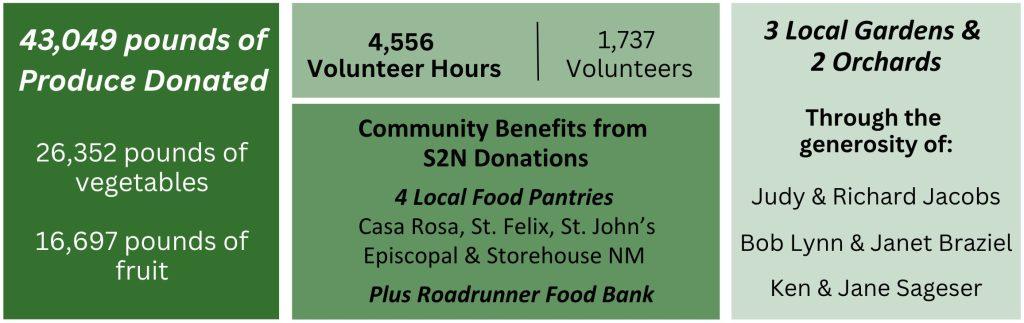
As we wrap up the 2025 growing season, we would like to extend our heartfelt gratitude to the donors, property owners, and volunteers whose generous contributions made this accomplishment achievable. Thanks to your commitment, effort, and financial support, we successfully harvested over 43,000 pounds of fresh produce to aid families in our community facing food insecurity.
_________________________________________________________________
2025 Community Impact by the Numbers
_________________________________________________________________
2026 Summary Recommendations
- Partner again with a local nursery to produce tomato, chile and bell pepper starts using deep inserts for stronger root systems.
- Work on improving the soil composition / quality in all gardens.
- Partner with community organizations to continue building a consistent and sustainable volunteer base.
_________________________________________________________________
2025 Achievements
Successful Harvest Season (43,049 lbs.)
The 2025 harvest season yielded standout crops including quality fruits, squash, cantaloupe, cucumbers, and sweet potatoes. Unlike last year’s fruit harvest, which was impacted by late freeze(s), this year’s fruit harvests were abundant, providing numerous varieties of apples, peaches, and pears to food pantries.
Cantaloupe and sweet potatoes, which were experimental in the past, saw significant yield increases, while reliable Eureka cucumbers produced well until they experienced cucumber beetle pressure. Chile matured slowly but was available throughout the season, aided by a new training resource for volunteers on picking quality chile.
Cages
A total of 150 sturdier cages were constructed for the 2025 growing season to replace thinner, damaged ones. These new cages effectively protected cucumbers and melons from hungry rabbits and ground squirrels. However, some ground-dwelling melons were lost to critters, and adjustments to cage placement are needed for easier harvesting, as some melons became trapped despite our best efforts in adjusting the vines.
Partner Organizations and Volunteers
S2N focused on outreach for more volunteers this year, participating in events at the Loma Colorado library and a Rail Yard event, and giving presentations to various organizations. We are continuing efforts to secure a youth organization from New Mexico for 2026 and we are partnering with groups, schools, and businesses for team-building events. Mail Chimp, Facebook, Instagram, and the S2N website are key outreach methods.
_________________________________________________________________
2025 Challenges
Invasive Broomrape Update
A native species of Riparian Broomrape (Aphyllon riparium) was present in one garden though not as prolific as in 2023/2024 when tomatoes were the main crop. This year it was found growing in the chile. Removal methods were undertaken wherever the species was found, based on input from an expert on the topic. A row of test tomatoes grown at the southern-most end of one garden did not have any evidence of the invasive species. We’ll continue to grow a few more rows of tomatoes in this location and monitor closely.
Soil Quality
Consultations with local experts revealed the need to address compacted soil and soil health. In the past we have added soil amendments such as compost and nutrients based on soil analyses. We will continue this practice, but in addition, will add more compost, not “rip” the soil (which breaks up compaction but also has the undesirable result of destroying bacteria and fungi in the soil) and look for additional ways to improve soil health such as considering a future cover crop in the winter.
Pests/Challenges
The majority of the tomato crop, due to the Broomrape issue, was grown in one garden. While we would normally practice crop rotation in the two gardens, this was not a viable option. The tomato plants did not grow as expected with a few exceptions. The plants were stunted and small throughout the garden, though they did produce a decent yield.
Consultation with several people resulted in recommendations regarding soil composition and quality as well as the discovery of Root Knot Nematodes, a microscopic roundworm. Root Knot Nematodes produce galls on plant roots stunting their growth. This is the recurrence of an issue in the S2N gardens first seen in 2014. Several applications of the biologic Actinovate was the remedy at that time. Actinovate will also help with leaf spot disease present on some of the later season tomatoes. Treatment will begin in the spring.
___________________________________________________________
We truly appreciate your continued support in helping Seed2Need provide fresh fruits and vegetables to families in our community who are experiencing food insecurity. Your involvement and ongoing support are deeply valued and make a significant difference in our mission.
Respectfully,
Seed2Need
Board of Directors and Leadership Team
Interested in volunteering? Click this Get Involved link and fill out the volunteer form to receive work session updates.


